
Newsletter May/June 2026

Dear All,
We have so much news this month that our Newsletter is a joint May/June edition. Besides that, its difficult being indoors when nature is so colourful and fresh! Enjoy!

We are beyond thrilled to announce that Kelly Conlin, our Director, has been nominated for Best Direction Short Documentary at the 2026 Leo Awards, July 4th and 5th, in Vancouver. The Leo Awards are BC’s Golden Globes, the red carpet, the dinner, the whole experience. Just can’t wait !!
On June 30, Telus STORYHIVE will be launching our documentary on their Telus Optik Channel. We will keep you posted with details.
Our Director, Kelly Conlin is still in the Film Festival arena and so we cannot launch on YouTube just yet, but we have discovered that we can send our link to teacher training colleges! This is now our 2026 campaign!
In celebration of the Telus STORYHIVE release The Whole Dyslexic Society is screening our documentary on the same day, Tuesday, June 30 at 7pm PDT. Please register HERE……. You will receive a Zoom link, and we look forward to seeing you there!
The reaction to our documentary, WHO KNEW, is constantly surprisingly wonderful and amazing. I keep thinking about how we put it together, the practice film, the structure, inviting the cast, confirming the filming locations, the filming, the editing. Maureen Levitt, our film mentor and Kelly Conlin were the only professionals amongst us.
Recently I remembered a similar overwhelming reaction. I was invited, actually I persuaded the incredible Professor Adele Diamond to invite me onto a panel discussion at UBC, long time ago. She was showing a film about dyslexia made by the International Dyslexia Association that made me feel sick; it was so patronising. I told her this and bravely, she allowed me onto the panel. The film makers spoke, the illustrious professor next to me spoke and then it was my turn to face an audience of professors, educational psychologists, speech pathologists, graduates, all with multiple degrees. I stood up knowing I was the only one in the audience without a degree and said “I found this film very difficult to watch, because I am dyslexic but I am certainly not learning disabled, I just learn differently from the way I was taught.” I sat down, that was it, nothing prosaic… and yet the whole room erupted in applause. I still get goosebumps when I think about it. I realised I was simply saying what everyone else knew already, I just happened to voice it.
Prof Diamond asked me to continue and I have a vague memory of saying teachers are going into their classrooms with one hand behind their backs. When I sat down the illustrious professor next to me whispered “well said”. I remember finding that annoying as he had the clout to alter the situation, he should have been out there making the changes needed. I politely said ‘thank you’. Manners are everything, lol.
That was the momentous moment I decided to write Fish Don’t Climb Trees … if people knew this already, then why not go for it. I am feeling the same about WHO KNEW as it is getting such an unexpectedly warm reception. Everyone knows its message already…we can’t wait to see what comes next !!!
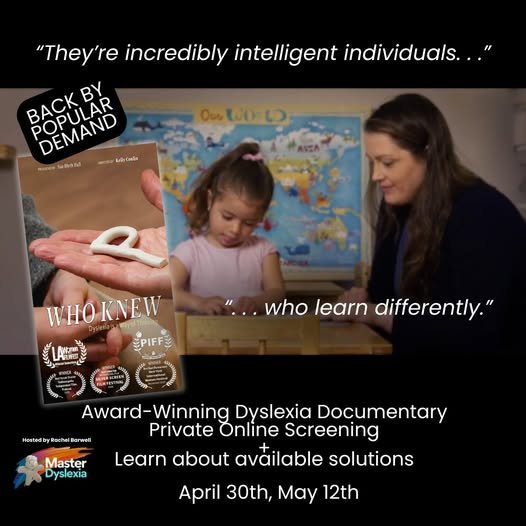
WHO KNEW down under – Rachel Barwell has screened the documentary in New Zealand with 515 total bookings across April 30 and May 12 events. She recorded a 42% show-up rate which is more than double the norm for a ‘cold’ audience. The audience was very engaged staying 30 mins after the events officially finished. There were a lot of teachers and learning support staff in the room. This brings the total screening bookings to 895 this year in NZ… just incredible !
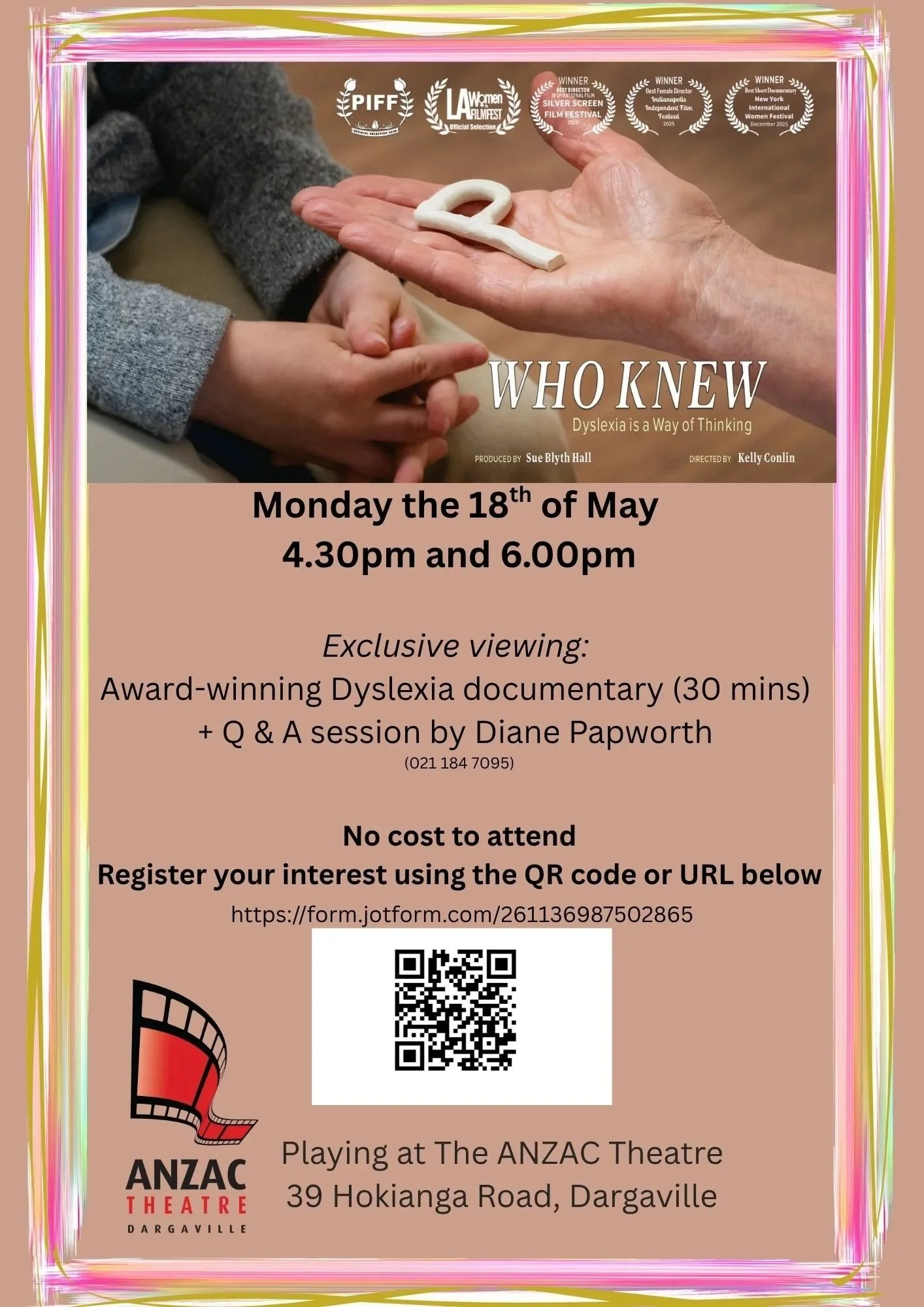
South Africa - Thank you to Cindy Henrico, Davis Facilitator, for her screenings this month. She reports how everyone was very moved and very enlightened by the film.
UK & Ireland - The team at Davis®UK & Ireland have been hosting monthly screenings and will continue to do so. They are hosted in the community space NeuroNavigators.

Join Us in Making a Difference
Support our efforts to bring the message of WHO KNEW Dyslexia is a Way of Thinking to more people around the world.
THE WDS
We held our AGM on Saturday April 25, and were thrilled to have some visitors, namely, Richard Whitehead who is the Director of Davis UK & Ireland and Joleen Bateman, the Executive Director of the Alberta Aboriginal Head Start Association. Laura will be posting the Minutes and Financials on our website shortly. This is always a good time to check in with ourselves, see what we have achieved and plan where we are going.
NEUROINCLUSIVITY FOR EARLY YEARS
Our second pilot, the first for the Alberta Aboriginal Head Start Association, drew to a temporary close on Monday May 25. We are collecting all the assignments and evaluations, from which we will create a Google Summary. This is vital when we apply for funding. We are already in the throes of creating a continuation! Those ECEs who returned to their centres with the tools and strategies are requesting a further pilot starting in September, so that the rest of their staff can attend. How wonderful is that? Those who attended this year would like a ‘Jump Start’ in September because they intend to implement what they have learned throughout their whole school year and then everyone in the centres will be on the same page.
This has been a very welcome and interesting learning curve. We will be making some adjustments to the course introduction. The two day hands-on course with Stacey Smith and Julie Brewer and the Manual scored full marks. We are very excited that those who attended in March are seeing the benefits of the tools we shared and we could not be more grateful to the AAHSA for their belief in what we do.

PICTURE GRAMMAR : www.picturegrammar.co.uk
I am delighted to say that you are now able to access Tessa Halliwell’s Picture Grammar HERE. It is the perfect provider of inspiration if you are stuck on how to represent the meaning of a trigger word as you complete your program follow up. Some of these words are very difficult to understand and make a model that really provides the whole meaning. A huge thank you to Tessa for publishing this incredible resource.
Picture Grammar, a new way of accessing the meaning of parts of speech and many of the sight or 'tricky words' that are often the stumbling blocks for fluent reading , spelling and comprehension.
It is ideal as a reference resource for dyslexics, visual thinkers, or those learning English as a foreign language it. It was developed to promote awareness of the logical relationship between three parts of a word as described by Ron Davis for the foundation for literacy mastery, and to raise money for the Gifts of Dyslexia Bursary fund (the UK equivalent of our program sponsorships).
OCEAN SONG SCHOOL Inspired by Waldorf Education

Recently, Sue was privileged to be invited to attend a meeting of four wonderful human beings who are bringing together a Waldorf inspired School in Victoria, BC. They will start with Kindergarten and grow it from there. Sue has always felt that Waldorf and Davis are a perfect match and is looking forward to exploring that possibility. Waldorf Education offers nurturing, child-centric education, guided by child development, shaped by rhythm and grounded in care. Here is their website https://www.oceansongschool.ca/. Sue is planning to attend the Confident Parenting event on May 30… maybe see you there?
OUR PROGRAMS:
Sue would like to open up a discussion about the medications used to ‘treat’ ADD and ADHD. When she first trained, she was advised against providing a program to anyone on Ritalin or some such drug. The prospective client would have to have been off the drug for as long as he/she had been on it. Our official directive has changed and many Facilitators report that the current chemicals have no adverse effect on the delivery of our programs.
When a person has the ‘gift of dyslexia’, ie the natural ability to alter perception, they are able to think in 32 images/second, so it is hardly surprising that so many children and adults nowadays are being officially diagnosed as dyslexic with ADD and ADHD. If we listen to someone talking at 3-4 words per second and yet process 8 times faster, is it any wonder we drift off into our own thoughts?m The medical profession is unaware of our ability to alter perception and the speed of our thoughts.
Following a dive into brain function, Sue is curious to collect some of her own data and would like to know if you would agree/disagree with any of these statements.
Ritalin is a brand name for methylphenidate and Adderall contains mixed amphetamine salts. Although they contain different ingredients, they are both classified as CNS stimulants and are thought to work in a similar way – by increasing the concentrations of norepinephrine and dopamine in the brain.
Adderall contains a mixture of four different amphetamine salts, while Vyvanse contains only one type of amphetamine salt called lisdexamfetamine. The dependence risk (likelihood of becoming dependent or addicted) appears similar for both Adderall and Vyvanse.
Both work similarly by blocking the reuptake of two neurotransmitters (chemical messengers between nerves) norepinephrine and dopamine which means levels of these chemicals increase between nerve connections, helping reduce inattention and hyperactivity symptoms in children and adults with ADHD.
Amphetamines are stimulants.. the theory is that if you hit a stimulated person (an ADD, ADHD person) with a stimulant they cancel each other out.
Both Amphetamines and Methylphenidates may be habit forming.
Behavioral therapy is still recommended as a first-line treatment for ADHD in young children.
What would you like to add to this discussion, observations, concerns, recommendations? Would very much like to hear from those with experience of these medications.. please email Sue at meadowside1@shaw.ca .. thank you !
WRITING BY HAND and HANDWRITING So interesting... totally explains why typing notes in my phone never works.
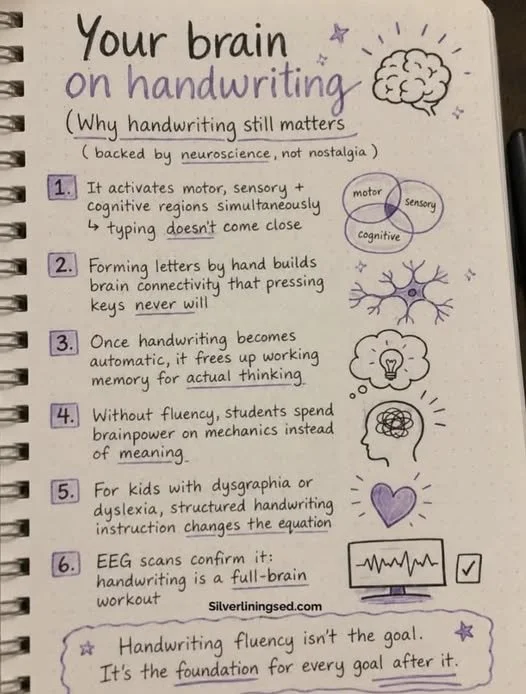
A Norwegian neuroscientist, Audrey Van der Meer, spent 20 years proving that the act of writing by hand changes the human brain in ways typing physically cannot, and almost nobody outside her field has read the paper. She runs a brain research lab in Trondheim, and the paper that closed the argument was published in 2024 in a journal called Frontiers in Psychology. The finding is brutal enough that it should have changed every classroom on Earth.
The experiment was simple. She recruited 36 university students and put each one in a cap with 256 sensors pressed against their scalp to record brain activity. Words flashed on a screen one at a time. Sometimes the students wrote the word by hand on a touchscreen using a digital pen, and sometimes they typed the same word on a keyboard. Every neural response was recorded for the full five seconds the word stayed on screen.
Then her team looked at the part of the data most researchers had ignored for years, which is how different parts of the brain were communicating with each other during the task. When the students wrote by hand, the brain lit up everywhere at once. The regions responsible for memory, sensory integration, and the encoding of new information were all firing together in a coordinated pattern that spread across the entire cortex. The whole network was awake and connected.
When the same students typed the same word, that pattern collapsed almost completely. Most of the brain went quiet, and the connections between regions that had been alive seconds earlier were nowhere to be found on the EEG. Same word, same brain, same person, and two completely different neurological events.
The reason turned out to be something nobody had really paid attention to before her work. Writing by hand is not one motion but a sequence of thousands of tiny micro-movements coordinated with your eyes in real time, where each letter is a different shape that requires the brain to solve a slightly different spatial problem. Your fingers, wrist, vision, and the parts of your brain that track position in space are all working together to produce one letter, then the next, then the next. Typing throws all of that away. Every key on a keyboard requires the exact same finger motion regardless of which letter you are pressing, which means the brain has almost nothing to integrate and almost no problem to solve.
Van der Meer said it plainly in her interviews. Pressing the same key with the same finger over and over does not stimulate the brain in any meaningful way, and she pointed out something that should scare every parent who handed their kid an iPad.
Children who learn to read and write on tablets often cannot tell letters like b and d apart, because they have never physically felt with their bodies what it takes to actually produce those letters on a page.
A decade before her, two researchers at Princeton ran the same fight using a completely different method and ended up at the same answer. Pam Mueller and Daniel Oppenheimer tested 327 students across three experiments, where half took notes on laptops with the internet disabled and half took notes by hand, before testing everyone on what they actually understood from the lectures they had watched.
The handwriting group won by a wide margin on every question that required real understanding rather than surface recall. The reason was hiding in the transcripts of what the two groups had actually written down.
The laptop students typed almost word for word, capturing more total content but processing almost none of it as they went, while the handwriting students physically could not write fast enough to transcribe a lecture in real time, which forced them to listen carefully, decide what actually mattered, and put it in their own words on the page.
That single act of choosing what to keep was the learning itself, and the keyboard had quietly skipped the choosing and skipped the learning along with it. Two studies. Two countries. Same answer. Handwriting makes the brain work. Typing lets it coast.
Every note you have ever typed instead of written went into your brain through a thinner pipe. Every meeting, every book highlight, every idea you captured on your phone instead of on paper was processed at half depth. You did not forget those things because your memory is bad. You forgot them because typing never woke the part of the brain that would have made them stick.
The fix is the thing your grandmother already knew. Pick up a pen. Write the thing down. The slower road is the faster one.
Article: https://www.facebook.com/photo/?fbid=26793094180341841
Swedish schools are cutting back on technology in schools: https://www.bbc.com/news/articles/cly0vk77vdko
Calendar:
May 30 – 10am Ocean Song Waldorf School, confident parenting https://www.oceansongschool.ca/
June 10 – Shelley Tice and Sue Hall thank the 100 Women Who Care for their generous donation. Mary Winspear Centre, Sidney, BC
June 30 – Telus STORYHIVE release WHO KNEW Dyslexia is a Way of Thinking onto their channel
June 30 – The WDS celebrates with a private screening of WHO KNEW, 7pm. Pease register HERE….
September - date to be confirmed – we extend our NeuroInclusivity for Early Years pilot with the Alberta Aboriginal Head Start Program
Sept 24 – Julie Brewer and Sue Hall speak to the South Vancouver Island Child Care organisation
October – date to be confirmed - Sue presents at a Professional Development Day on Cortes Island
Lots to think about as this school year comes to a close. As you start to relax and hopefully have time to rejuvenate and think, please consider any help you can give this Society. Our opportunities are expanding, and our man(woman)power stays the same. If you have book-keeping experience, minute taking, grant researching/writing experience please let us know. THANK YOU for being part of a huge wake up call for everyone.. WHO KNEW Dyslexia is a Way of Thinking.. in fact… very few people know and we are changing that!
Very warm thoughts from us all,
Sue, Laura, Julie, Maureen, Sharon, Paddy, Gisa, Del, Tristan
info@thewds.org
