

Dear Friends,
Spring is officially here and we are all coming out of hibernation! Having spent a week in Edmonton in March, I will never complain about rain and wind any more.
The Alberta Aboriginal Head Start Association was very keen for their Early Childhood Educators to take part in our second NeuroInclusivity for Early Years pilot. Paddy Carson, a Davis Facilitator in Edmonton, generously hosted Julie Brewer, Desi Bissell a Facilitator in Red Deer and myself. Stacey Smith came to present the two days and Larry Smith was able to film it all. Everything went very smoothly and a huge thank you to all those who took part and made it happen. We continue to support the ECEs via 8 Assignments and look forward to all their comments and suggestions.
Personally, I spent a great deal of the time disoriented. I left in PST … arrived one hour ahead in MST… the clocks changed for BC and Alberta over the weekend. My laptop decided to stay in BC time, which was now PDT, one hour behind Alberta…my phone wanted to be the new MDT so one hour ahead of my laptop…and I decided my watch was going to be the local time wherever I was. While there, I had to coordinate three Zoom screenings, one in UK time, so GMT, and two in BC time from Alberta! Hope that’s confusing enough.. and all I can say is thanks heaven for Laura!
We have a great deal of VERY EXCITING NEWS… where to start ?

WHO KNEW Dyslexia is a Way of Thinking is being screened at the Pasadena Film Festival, in North Hollywood on April 11 and Kelly Conlin, our Director is going! She will have a chance to take questions afterwards. Apparently this festival is well attended by celebrities, so we will give her a list of dyslexic celebrities to hunt out 😊

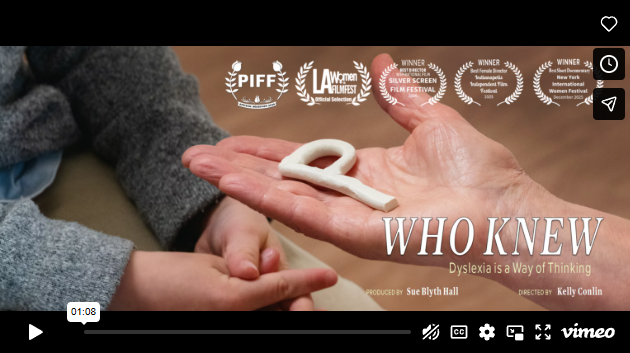
Watch Trailer HERE
WHO KNEW also made its Pacific debut this month.
March 3– two weeks before Nikki Palamountain’s NZ screening of WHO KNEW, Nikki invited Sue to join her on Radio Hawkes Bay. Listen HERE>
Tuesday 17th March at 7pm Australian Eastern Daylight Time, PACIFIC REGION PREMIERE, hosted by Jan Stead, assisted by Rachel Barwell.
and again on Friday 20th March at 8pm to allow for different time zones.
Tuesday March 24th: Rachel Barwell held her first screening in New Zealand. “It went very well tonight - the film was really well received, and people had a lot of deep and intelligent questions and reflections. There were a total of 74 people in attendance, which also included 5 Davis facilitators. We have over 250 bookings so far across the week, so I'm confident A LOT of people are going to be exposed to your beautiful film in NZ, Australia and Africa! this week!
Saturday March 28th NZ time, Friday March 27th 7pm Vancouver Island time, Rachel invited Laura O’Neill and Sue to attend a screening. “Yesterday’s Grand Finale was the perfect end to a week that saw over 395 New Zealand families join the conversation. The questions proved that Aotearoa (NZ) is ready to change the map for our 3D thinkers.” Laura and Sue were so honoured to be part of this.. it was thrilling to see it well attended.
Shortly after the screening Rachel was interviewed on Coast Access Radio. Listen Here>
Upcoming Screenings!
Wednesday, April 8th, 7PM UK time/11AM Pacific time. This private screening is available at NeuroNavigators by Davis® UK & Ireland. Everyone welcome! Free to join HERE>
April 30th & May 12th, 7PM NZD time. With Rachel Barwell (Davis Facilitator). You can visit her Facebook post HERE> Or, visit her booking form HERE>
The next continent is Africa… can you believe it.. because we certainly can’t!
Until our documentary can be on general release we are taking bookings for private screenings. Contact Sue Hall at info@thewds.org for details. The general release is expected in 2026 on TELUS Optik TV and the STORYHIVE YouTube channel all made possible with the support of TELUS STORYHIVE Editions and supporters like you! https://www.thewds.org/documentary-who-knew

100 Women Who Care, North Saanich Branch:
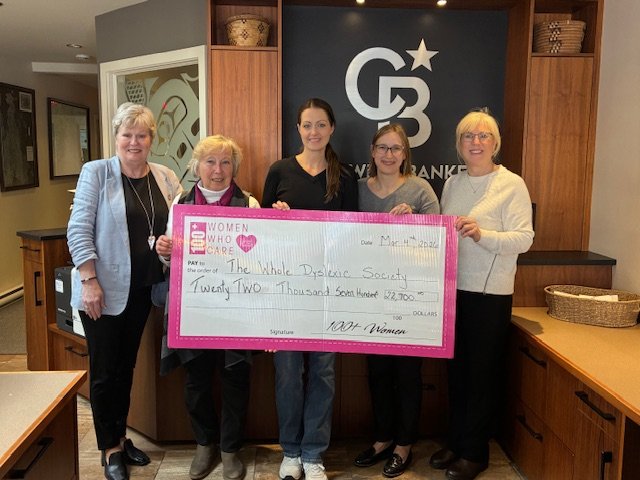
100 Women Who Care, North Saanich Branch: Some of you may remember the first time Sue went to a meeting of 100 Women Who Care in West Vancouver, the WDS pitch was pulled out of the box, she spoke to it, and we won, $10,000. Two years ago Gisa Straith put in a pitch
for us, it was pulled out, she spoke to it and we were awarded $10,000.
Shelley Tice, here in North Saanich had joined the Victoria 100WWC and
recently decided to switch to the North Saanich chapter. She has pitched
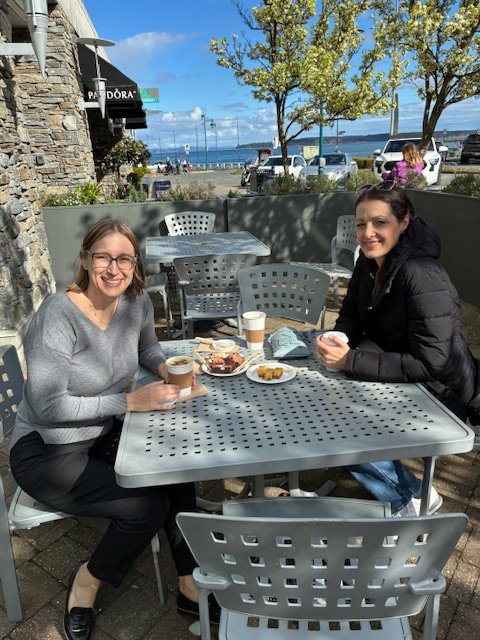
for us four times and at the March meeting, she spoke and the WDS was awarded. $22,700 because they have 227 Women Who Care!!! How incredible is that? We are beyond grateful to her. These funds could not have arrived at a better time as we have our AGM on April 25, and still so much to plan. Sue will speak at their next meeting to share how the funds will be spent. Shelley, Julie and I had to celebrate after holding that enormous cheque! Thank you to everyone involved.
If you’re inspired by this model of collective giving, we encourage you to learn more about 100 Women Who Care and consider getting involved in a chapter near you. It’s a powerful and simple way to make a meaningful impact in your community.
Ron Davis’ autobiography, Dummy, is now available on Amazon in both print and Kindle formats.

In this deeply personal account, Ronald D. Davis shares his early life experiences growing up with autism and dyslexia—labeled “dummy” and struggling in a world that didn’t understand how he thought. His journey is one of resilience and discovery, ultimately leading him to unlock the root of his own learning challenges.
Ron went on to become a successful engineer, artist, and the founder of the Davis Dyslexia Association International. His work has helped individuals around the world recognize and harness their unique thinking styles through the Davis® methods.
Dummy reveals a remarkable journey that reshapes how we think about intelligence and learning.
Kudos to Richard Whitehead (Director Davis® UK & Ireland) for taking on the publishing and helping bring this important story to a wider audience.
Richard has also launched NeuroNavigators by Davis® UK & Ireland, a community-driven platform designed to support parents, educators, professionals, and neurodivergent individuals at the very start of their journey.
Many families first encounter Davis during moments of challenge. NeuroNavigators aims to meet them earlier—at the stage of curiosity—by offering accessible education and a strengths-based approach before they begin a one-to-one program.
The community provides free webinars on dyslexia, ADHD, autism, and other learning differences; interviews with Davis Facilitators and program graduates; practical tips for parents; and a welcoming space for discussion. It serves as a bridge to deeper engagement with Davis programs and Facilitator training.
NeuroNavigators has also hosted screenings of our documentary, helping to broaden public understanding of dyslexia as a unique way of thinking.

SHARON’S CORNER
TECHNOLOGY, a Friendly Foe – Sharon Roberts
In response to increasing concerns over excessive use of screen time, government agencies and school boards have put controls on its use. Despite these efforts, a recent Statistics Canada study has found that nearly 40 per cent of Canadian youth appear to be exceeding screen time recommendations.
The study analysed Canadian youth cohorts at two different points of time: in 2019, when they were aged 12 to 17, and in 2023, when the same group was aged 16 to 21. Average grades were found to be higher among youth who met screen time recommendations in both surveyed years. In addition, those who met the guidelines seemed to have a more positive perception, especially as it pertains to body image.
Generally, screen time for children varies by age, with a strict recommendation of no screen time for those under two years old. For children aged 2-5, limit recreational screen time to less than one hour daily, while children aged 5-17 should have under two hours daily, excluding homework. The reasons why vary, but basically it contributes to memory loss, sleeplessness and emotional regulation. It also triggers addictive dopamine loops according to Stanford Lifestyle Medicine.
If that is not scary enough to motivate an at-home reduction policy, there is a risk of predators and bullying. The recent ruling against Meta confirms this idea. It has been ordered to pay $375 million after it was found to violate the state’s unfair practices. It was alleged that the company failed to properly safeguard its apps from online predators targeting children. At this time, there is a second ruling in California subject to a substantial fine.
So how can you cut back on screen time? Here are a few ideas:
1. Be a good role model with your own screen use—on all devices.
2. Turn off devices for mealtimes, when reading with your child, or when doing things together as a family.
3. Turn off screens when no one is using them, especially background TV.
4. Avoid using screens for at least 1 hour before bedtime and keep all screens out of your child’s bedroom. They interfere with sleep.
5. Choose healthy activities— like reading, outdoor play, and crafts— instead of screen time.
Calendar:
April 6: AAHSA Assignment Four - Woosh balls
April 13: AAHSA Assignment Five - Letter Mastery
April 20: AAHSA Assignment Six - Concepts
April 23: South Vancouver Island Child Care online presentation – Julie and Sue
April 25: the WDS AGM and Business Meeting 10am-noon
April 27: AAHSA Assignment Seven - Picturing to Remember
May 16: AAHSA Assignment Eight - Discussion/Evaluation of Course
Kakamega Kenya Project:

Exciting things are happening in Kakamega! Geoffrey’s vision for inclusive, strength-based education continues to grow. Beyond the existing E-Zee Math Tutoring Centres, a brand-new kindergarten—Kakamega Global Star Academy—has opened, providing children with a supportive, understanding start to their learning journey.
Using principles aligned with the Davis® Methods, children are guided to understand how they learn, develop focus and awareness, and build confidence from the very beginning. Classrooms are designed so that all children learn together, at their own pace, celebrating their strengths and supporting neurodiversity from day one.
You can be part of this growing story. Donations help:
“Provide safe and stable learning spaces (rent for the school and centres)
Support teachers and staff who work closely with the children
Supply learning materials and equipment
Continue expanding this inclusive, strength-based model to reach more children”
Every contribution, big or small, makes a lasting difference.
💛 Support the Kakamega Initiative HERE>
To read the full article visit Claire Ashmore’s Growing Choices HERE>

Notice of AGM - April 25th, 10:00AM - 11:00Am
If you would like to join us please fill in the form HERE>
We had a great deal of news this month, we would always like to hear your news and let us know if you would like to come to our AGM!
Wishing you all a fabulous spring!
Sue, Laura, Julie, Maureen, Sharon, Paddy, Gisa, Del, Tristan
info@thewds.org
